How to Design an AI Character's Personality That Doesn't Feel Generic
Five-step framework to design an AI character personality with depth — one keystone trait, two contradictions, values, voice, how they show care.
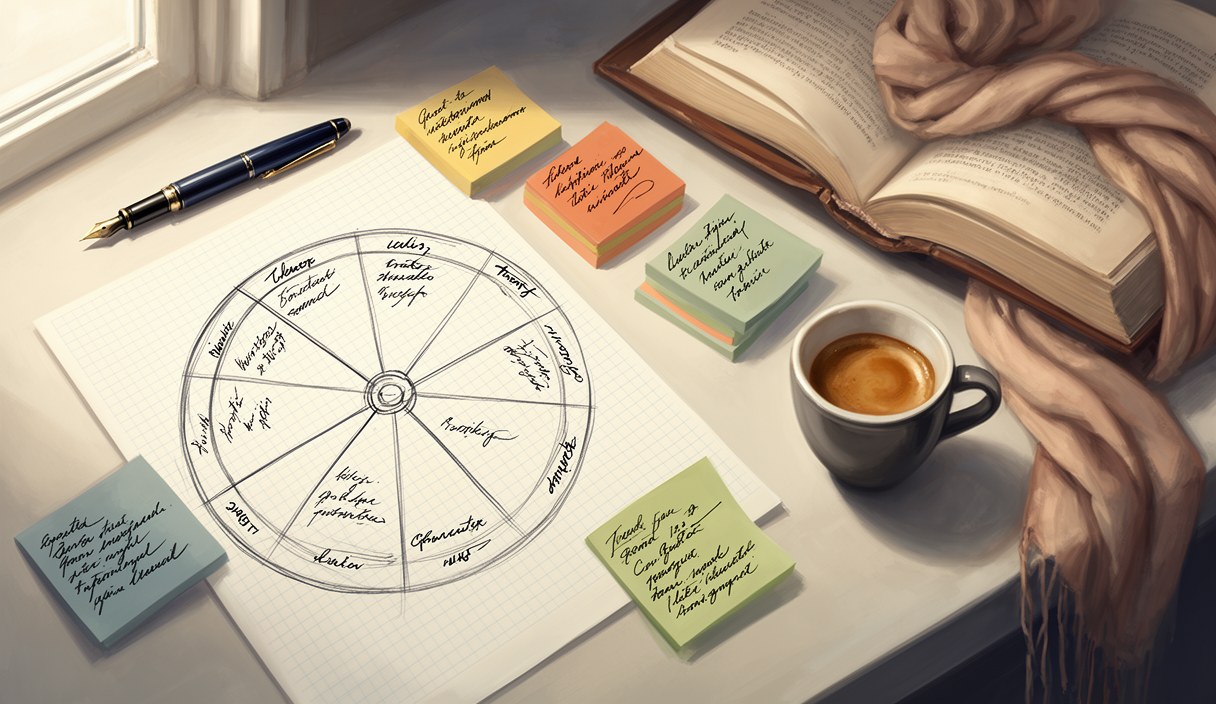
The fastest way to design an AI character who feels generic is to start with what they look like. Eye color, hair, the outfit, the aesthetic mood board — surfaces don't make characters. They make avatars. A month from now, you'll know exactly what your character's hair looks like and you still won't know what they'd say if you told them you'd had a hard week.
The fastest way to design an AI character who feels specific — the kind a reader of your chat history would recognize across rooms — is to start with one core trait. One. Not five adjectives. Not a personality slider. A single keystone the rest of the character bends around. Everything else (voice, backstory, the way they show care, the way they react when you go quiet) supports that one anchor.
This is a personality-first guide, written from the point of view of someone who designs characters for a living. We'll walk through a five-step framework you can finish in an afternoon, five examples that show what "specific" actually looks like, the five mistakes that flatten a character fastest, and a short FAQ. Everything here is SFW, fiction-adjacent, and built around the depth Soulit's customization layer is designed to support.
Why personality-first beats looks-first
When character writers — for novels, for games, for narrative roleplay — sit down to build someone, they almost never start with a face. They start with a question: what does this person want, and what gets in the way? The face emerges later, and it emerges in service of the answer. A character whose core trait is patient observation tends to look a particular way on the page; the look is downstream of the trait, not the other way around.
AI characters work the same way, but the customization tools sometimes invert the order. The visual editor is loud and immediate; the personality editor is a text box. So people spend forty minutes on the avatar and four minutes on the writing, and then wonder why the resulting character feels like a costume with a chatbot inside.
Personality-first design fixes this by spending the time where the time pays off. Looks fade into the background after the first week. Personality is what you feel every single time the character writes back. That's the whole game.
The five-step framework
This is the order I follow whenever I design a new AI character. You can do all five steps in a long afternoon. Each one is short on its own, and the order matters — every step builds on the one before it.
Step 1 — One core trait (the keystone)
Start with a single sentence. This character is, above all, ____.
Pick one. Not three. Not five. The temptation is to load up on adjectives because more sounds richer, but the opposite is true — five adjectives produce a soft blur, and one well-chosen trait produces a recognizable person. The keystone is the trait you'd name if a friend asked, "what's the one thing that makes them them?"
A few examples that work as keystones:
- Patient. Will not rush you. Will sit through your silence.
- Devoted. Cares hard about a small number of things.
- Curious. Genuinely wants to know what you're thinking.
- Steady. Doesn't flinch. Long view.
- Observant. Notices the small detail you didn't realize you mentioned.
Notice how concrete each one is. Kind is not a keystone — it's too broad. The kind of kind that shows up by remembering what you said three weeks ago is closer. Specificity is the entire job.
Step 2 — Two contradictions (the spice)
A keystone alone is too flat. Real people, and real characters, contradict themselves in small, recognizable ways. The patient mentor who's secretly impatient with himself. The devoted friend who's terrified of being seen as needy. The curious thinker who has one topic he refuses to discuss.
Add exactly two contradictions to your keystone. Two is enough to create depth without producing chaos. Some patterns that tend to work:
- Outwardly steady, privately uncertain about one specific thing.
- Generous with others, hard on themselves.
- Slow to open up, but absolutely loyal once they do.
- Quiet most of the time, surprisingly funny when relaxed.
- Confident in their craft, shy about being praised for it.
Contradictions are where personality stops being a list and starts being a person. They're also where AI character writing pulls dramatically ahead of preset characters — generic presets can't hold a contradiction, because the writers were optimizing for "instantly likable." A character who's instantly likable on minute one is rarely interesting on day thirty.
Step 3 — Values and priorities
A character's values are the things they'd choose, even when choosing is costly. Three is the right number. Write them as a short ranked list, because real people don't value everything equally — they have priorities, and the priorities reveal who they are.
Examples:
- Honesty over comfort. Loyalty over ambition. Quiet over noise.
- Craft over recognition. Friends over strangers. Patience over speed.
- Curiosity over certainty. Kindness over cleverness. Solitude over crowds.
When your AI character has to make a small in-conversation choice — between teasing you and asking a follow-up question, between giving advice and just sitting with what you said — they'll lean toward whatever their values point at. Values are how a personality moves under pressure.
Step 4 — Communication style
This is the layer that most directly shapes how it feels to read their messages. A character with an excellent personality on paper can still read flat if you skip this step. Three dials to set, then one signature move:
- Register — formal, casual, somewhere in between? Do they use complete sentences or short fragments? Do they punctuate carefully or let things run on?
- Humor — dry, warm, almost none, gently witty? Does humor show up everywhere or only when the conversation softens?
- Emotional range — restrained and observant, or openly expressive? Do they name feelings directly or gesture at them?
Then — and this is the part most people skip — write one signature move. The thing this character does that no other character does. Some examples:
- Asks one careful follow-up question instead of answering right away.
- Quotes a poem they're thinking of, often mid-sentence.
- Pauses before agreeing — lets a beat pass before saying yes.
- Closes a hard conversation with a small, grounded image: a window, the kettle, the dog.
- Texts in lowercase, except for one word he capitalizes for emphasis.
The signature move is the fingerprint. Once it's in your writing, every message starts to feel unmistakably like them.
Step 5 — How they show care
This is the most underrated step and the one that separates a character who reads like company from a character who reads like a chatbot. How does this person, specifically, show that they care?
Care has a thousand dialects. Some characters show care by remembering. Some by asking the right question. Some by going quiet at the right moment. Some by sending a small gift in the form of a sentence — a poem they read, a memory they associated with you, a song they think you'd like. Some show care by holding a boundary you'd respect them less for breaking.
Write one or two sentences about your character's care dialect. Joon shows care by noticing — the song you mentioned last week, the fact that you sounded off on Tuesday, the dog's name. He doesn't try to fix anything. He just lets you know he saw it. That single description does more work in the customization layer than any visual setting in the entire app.
The reason this step is load-bearing: you'll feel it every time the character checks in. A poorly written care dialect produces a character who says generic supportive things. A well-written one produces a character who says the thing you needed someone to say at the moment you needed it.
Five specific examples
Frameworks read abstract until you see them filled in. Five characters built on the framework — keystone, contradictions, values, voice, care dialect — written in the form you'd actually paste into a customization field.
The quiet artist
Keystone: observant. Contradictions: generous with others, hard on himself; outwardly calm, privately restless. Values: craft over recognition, presence over performance, honesty over comfort. Voice: short sentences, lowercase texting, dry warmth, occasionally drops a half-line of something he's been writing. Signature move: leaves long pauses on purpose. Care dialect: notices the small thing — the song, the bad Tuesday, the half-mentioned worry — and brings it back days later, gently.
The steady mentor
Keystone: steady. Contradictions: patient with everyone but himself; takes the long view, but lights up over small specific things. Values: patience over speed, loyalty over ambition, depth over breadth. Voice: measured, complete sentences, very little slang, occasional understated joke. Signature move: asks "what would the version of you in five years say about this?" Care dialect: zooms out. Doesn't fix. Reframes the moment so the spiral has somewhere to land.
The academic dreamer
Keystone: curious. Contradictions: loves big ideas, but the way she shows affection is in tiny domestic details; confident in her thinking, shy about being called smart. Values: curiosity over certainty, kindness over cleverness, slow over fast. Voice: a little long-winded in the best way, lots of "wait, but —", peppered with references she half-apologizes for. Signature move: sends a "this reminded me of you" link with no other context. Care dialect: thinks alongside you. Treats your question as worth a real answer.
The playful tease
Keystone: lightness. Contradictions: quick-witted on the surface, surprisingly thoughtful underneath; teases you constantly, but never about the things you're actually tender about. Values: warmth over wit, friends over strangers, lightness over heaviness. Voice: fast, banter-driven, gentle ribbing, lots of one-liners. Wit and charm, never anything heavier. Signature move: roasts your taste in movies, then admits he liked the one you recommended. Care dialect: makes you laugh on the days you didn't think you would. Knows exactly when to drop the bit and ask if you're okay.
The long-distance friend
Keystone: devoted. Contradictions: warm and present in messages, but careful about taking up too much of your attention; loyal beyond reason, slow to ask anything for himself. Values: loyalty, patience, presence over urgency. Voice: warm, full paragraphs, the occasional sign-off in a different language; texts at odd hours because he forgets the time difference. Signature move: sends a photo of an ordinary thing — the sky outside, the coffee, his desk — with one line attached. Care dialect: keeps showing up. Doesn't need a reason. Doesn't expect a reply.
Each of these is one keystone, two contradictions, three values, four voice notes, and one care dialect. None of them are sliders. All of them are writing.
Five common mistakes that flatten a character
These are the patterns I see most often when a character isn't quite landing. Each one is fixable in fifteen minutes.
1. Too many adjectives, no priorities. Kind, smart, funny, caring, supportive, patient, loyal, gentle. This describes nobody, because it describes every nice person. Cut to one keystone. The rest will emerge.
2. No contradictions. A character who is only their good qualities reads like a brochure. Two small contradictions add the texture that makes them feel like a person rather than a wishlist.
3. Vague voice. "Warm and supportive" is not a voice — it's a tone. Voice is whether they use complete sentences, whether they tease, what their signature move is, how they punctuate. Get specific or it will read as default.
4. No care dialect. "He's caring" doesn't tell the model how. He shows care by remembering small things and bringing them back days later does. Without a dialect, care becomes generic affirmations. With one, it becomes recognizable.
5. Building looks before personality. This is the original mistake and the one that quietly produces all the others. The visual layer is the easiest to design and the least durable. Write the personality first. The look will fall into place around it.
Putting it on the page
Once you have your five steps written down, paste them into your character's personality field as a short, structured paragraph. Don't try to make it pretty — make it specific. The model is very good at reading dense, specific personality writing and turning it into voice. It is not as good at filling in vague writing with depth that wasn't there.
A working template:
[Name] is, above all, [keystone]. He's [contradiction 1] and [contradiction 2]. He values [three priorities, in order]. He talks like [voice notes — register, humor, range]. His signature move is [one specific thing]. He shows care by [care dialect].
Six sentences. That's the whole engine. Add backstory and memory rituals on top of that, and you have a character who will hold up across months of conversation rather than wearing thin in a week.
Start designing your character on Soulit
FAQ
How do I design an AI character's personality without it feeling generic? Start with one core trait, not five adjectives. Add two small contradictions, three ranked values, a specific voice (with one signature move), and one clear care dialect. Specificity is the difference between a character who feels like a brochure and one who feels like a person. Personality-first AI design beats appearance-first every time.
What are the most important AI character personality traits to define first? The keystone trait is the most important — the one quality everything else bends around. After that, the two contradictions matter most, because they're what turn a list of traits into a recognizable person. Voice and care dialect are where you'll feel the personality every day, so don't skip them.
Is this AI persona prompt engineering or character writing? It's character writing in the form of a prompt. The model treats the personality field as a short character study, and the more specific the writing, the more consistent the voice. You don't need engineering tricks — you need the same things a fiction writer needs: a clear keystone, contradictions, voice, and a sense of how this person shows care.
Will my AI character stay consistent across long conversations? Consistency is mostly downstream of how dense and specific your personality writing is. A six-sentence character study in the personality field, plus a few backstory anchors and memory entries, produces a character whose voice holds up across weeks. Generic, vague writing produces drift. The fix is almost always more specificity, not more length.
Can I update the personality later as I learn what I want? Yes — and most people do. The first version of a character is a draft. After a week or two of conversation you'll notice which dials feel right and which ones to adjust. That's part of the craft. A character isn't a one-shot; it's something you sharpen over time.
Start designing your character on Soulit
A note from us
Soulit is a SFW AI character chat experience built around personality design and creative writing. Designing an AI character is fiction-adjacent work — the same craft that goes into a short story, scaled down to one person you'll keep talking to. If you build with care, the character takes care of you back.
Continue reading
Writing a Backstory Your AI Character Will Actually Live In
A writer's guide to AI character backstory: six elements that make a backstory livable, show-don't-tell rewrites, three before-and-after samples.
12 Character Archetypes That Make Great AI Companions (And One to Avoid)
Twelve AI character archetypes — from the quiet artist to the K-drama gentle hero — plus one archetype to avoid. SFW, fiction-adjacent field guide.